
Entry 12Third watch · Rules & Safety4 min
Two chores bring every boat back to the dock: buying fuel and emptying the holding tank. In Fort Lauderdale the second one is free at several city locations, and the first comes with rules worth knowing before you call a fuel truck.
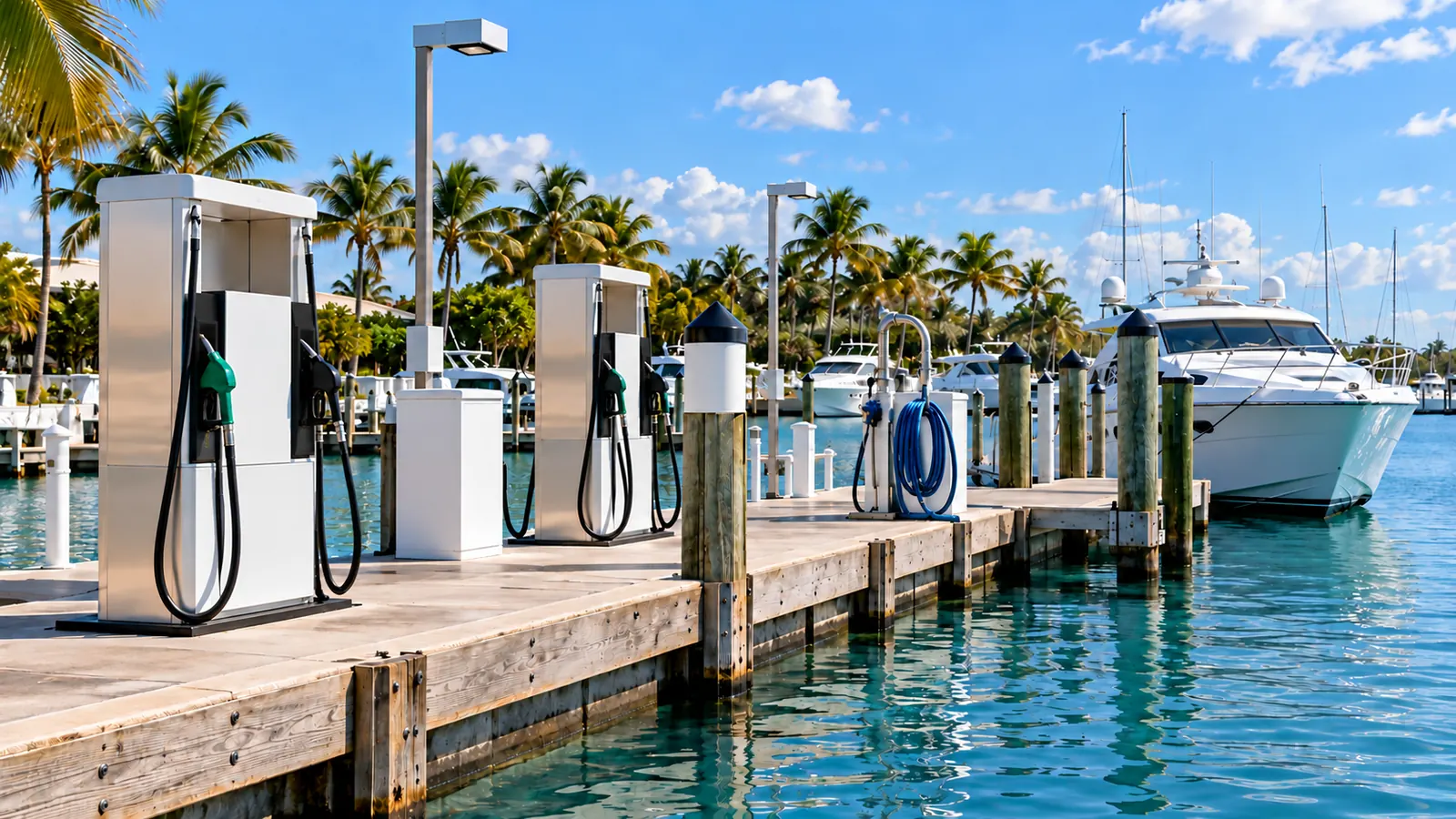
The city’s free pump-out stations
The City of Fort Lauderdale operates four complimentary pump-out locations for marine vessel sewage, open to the public:
| Location | Address | Type | Hours |
|---|---|---|---|
| Cox’s Landing Boat Ramp | 1784 SE 15th Street | Self-service | 24 hours a day |
| Smoker Park | 501 S. New River Drive | Self-service | 24 hours a day |
| Marshall Point | SW 4th Avenue | Assisted only | 8:30 a.m. to 4 p.m. |
| Cooley’s Landing Marina | 450 SW 7th Avenue | Assisted only | 8:30 a.m. to 4 p.m. |
The city said a mobile pump-out service was coming in spring 2026; call the marine office at (954) 828-4626 or (954) 828-5423 to ask whether it serves your location. Slips at Cooley’s Landing and the New River downtown docks also have sewage connections.
Why pump-outs matter: Florida’s sanitation law
Section 327.53 of the Florida Statutes sets the rules for every boat on state waters:
- Every vessel 26 feet or more in length with an enclosed cabin and berths must have a toilet. On boats other than houseboats it may be portable or permanently installed.
- A permanently installed toilet must be attached to a Coast Guard certified or labeled marine sanitation device.
- Raw sewage may not be discharged from any vessel, including houseboats, or any floating structure in Florida waters.
- If a boat is plumbed so a toilet could flush overboard or a holding tank could be emptied into the water, the valve must be set to prevent discharge and locked or otherwise secured while on state waters.
- Waste from Type III marine sanitation devices must be disposed of at an approved pump-out facility.
Violations of these sanitation rules, and of the rules for no-discharge zones, carry a civil penalty of $250 under section 327.73. The law says those penalties go to a state trust fund used in part to build and run pump-out stations and to educate boaters about them.
Tip: Make securing the overboard valve part of your departure checklist; the law requires it to be locked or secured whenever the boat is on state waters.
Proof of pump-out for longer stays
Florida also lets local governments require owners of boats subject to the sanitation law to show proof of proper sewage disposal, such as a pump-out receipt, when they stay anchored or moored for more than 10 consecutive days in a permitted mooring field or a federal no-discharge zone, and to set pump-out requirements for live-aboard vessels anywhere in their jurisdiction. Before a local government can adopt such a rule, approved pump-out services must be available within its area. Keeping your pump-out receipts costs nothing and answers the question if it is ever asked.
Floating structures with enclosed living space and berths, or working space open to the public, must have a permanently installed toilet connected to a Type III device or plumbed to shoreside sewage, and may not be plumbed to discharge into the water.
Fueling at the city docks
At its downtown docks, the city allows fueling by truck at one place only: slip SNR-43. The city’s rate card says the service is complimentary to in-house guests of its marine facilities; all other vessels are charged one night’s dockage at the daily rate. You arrange the slip through the downtown office at (954) 828-5423, and the fuel supplier must have proper spill insurance and equipment before fueling.
Marinas with fuel nearby
NOAA’s Coast Pilot, the official sailing directions, lists several Fort Lauderdale-area facilities with fuel. Services change, so call ahead:
- Bahia Mar yacht basin, on the east side of the Intracoastal about 0.4 mile south of the Las Olas Boulevard bridge: gasoline, diesel, water, electricity and supplies, with berthing arranged by its dockmaster.
- A large marina at the entrance of the Mercedes River, on the Intracoastal near Mile 1065.7: gasoline, diesel, water, ice, electricity and berthing.
- Lake Santa Barbara, on the west side of the Intracoastal near Pompano Beach: berths with gasoline, diesel, water, ice and pump-out, plus repair yards.
Keeping fuel out of the water
- Fill portable tanks ashore when you can, not aboard.
- Know your tank’s capacity and stop short of full to leave room for expansion in the heat.
- Keep an absorbent pad at the fill and the vent while fueling.
- Close hatches while fueling a gasoline boat, then run the blower before starting the engine.
For where to keep the boat between trips, see Fort Lauderdale’s City Marinas: Cooley’s Landing and the New River Downtown Docks and Renting a Boat Slip in Fort Lauderdale: How Dockage Is Priced and What to Ask Before You Sign. If you live aboard, the pump-out rules matter even more; see Living Aboard a Boat in Fort Lauderdale: What Florida Law Says and What to Ask a Marina.