
Entry 03First watch · Slips & Marinas4 min
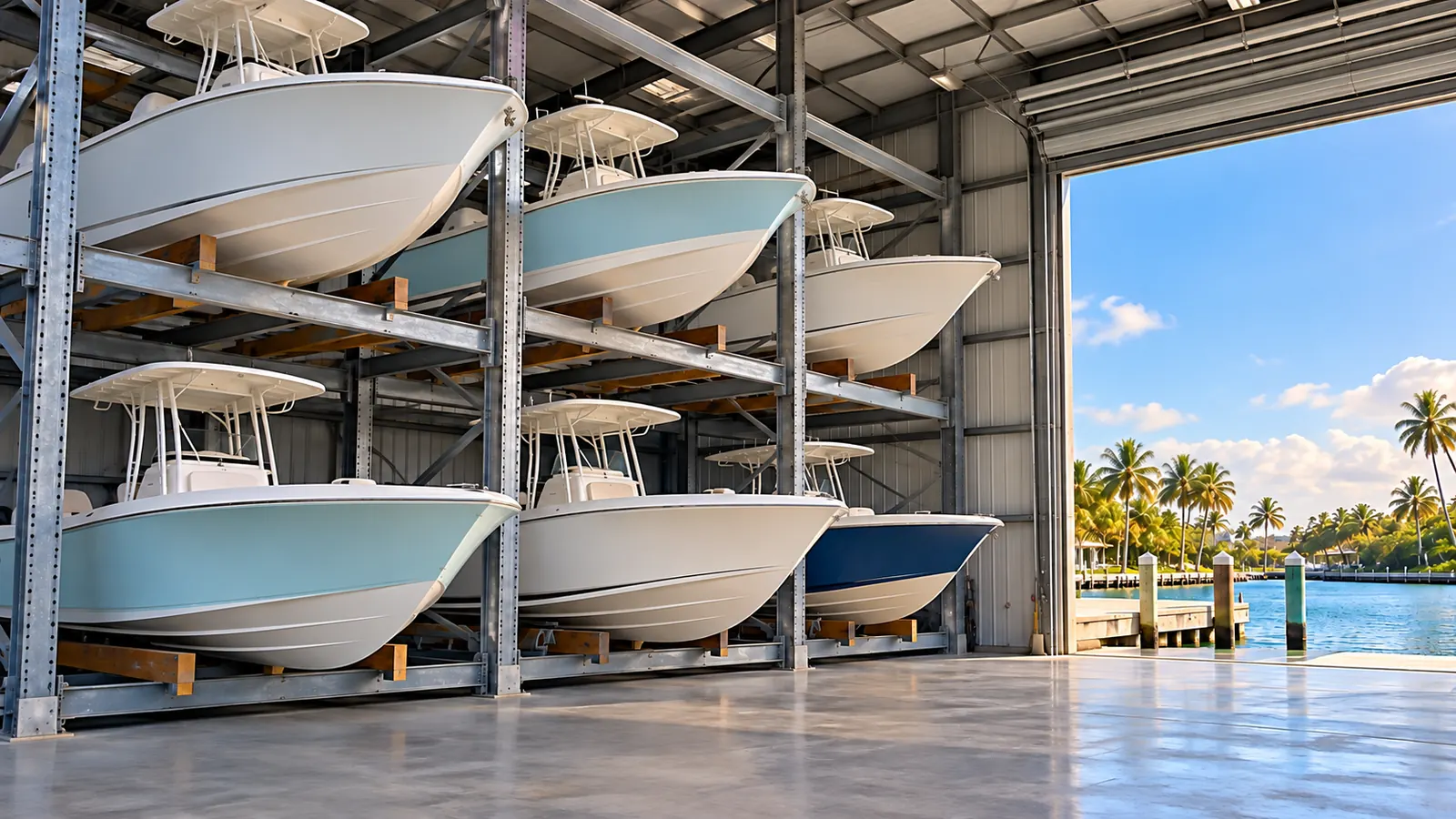
In Fort Lauderdale a boat lives in one of two places: in the water, tied to a dock, or out of it, on a trailer or a rack in a storage building. A wet slip means the boat is ready the moment you step aboard. Dry stack storage, where a marina lifts boats out of the water with a forklift and stacks them on racks indoors or under a roof, means the hull spends most of its life dry. Which one makes sense depends on the boat, how often you use it and how you plan to handle hurricane season.
What each option is
- Wet slip: a berth at a dock where the boat floats full time, usually with power and water connections. You arrive, cast off and go.
- Dry stack: the boat sits on a rack ashore. You call ahead, the marina launches it, and staff put it back on the rack when you return. Dry stack is generally for smaller powerboats that a forklift can lift.
- Trailer at home: the cheapest storage if you have room and a tow vehicle, but you launch at a ramp each time; see Launching at a Fort Lauderdale Boat Ramp: City Ramps, Paperwork and a Smooth Launch.
How the costs are structured
Wet slips are priced by length. The City of Fort Lauderdale’s rate card, for example, charges per foot per day with a 35-foot minimum at all its facilities, adds 7 percent sales tax, and bills electricity separately according to the size of the shore-power connection. A 25-foot boat in a city slip is billed as if it were 35 feet long, so smaller boats pay more per foot of actual length. Our worked example of those rates is in Renting a Boat Slip in Fort Lauderdale: How Dockage Is Priced and What to Ask Before You Sign.
Dry stack facilities set their own prices, and they are rarely published, so ask for a written quote. Ask what is included: the number of launches, whether there is a fee per launch or for holidays, washdown after each trip, and how far in advance you must call.
A side-by-side checklist
| Question | Wet slip | Dry stack |
|---|---|---|
| Ready to go? | Immediately | After the marina launches it, on its schedule |
| Boat size | Limited by slip length and depth | Limited by forklift and rack capacity |
| Power and water | Usually available, billed separately | Usually none while on the rack |
| Living aboard | Possible where the marina and local rules allow | Not possible |
| Storm planning | Lines, fenders, or moving the boat | Depends on the building and the marina’s plan |
Hurricane season decides a lot
The Atlantic hurricane season runs from June 1 to November 30. NOAA’s Coast Pilot, the official sailing directions for these waters, says tropical cyclones come within 180 miles of Port Everglades once or twice a year on average, and that about half of them are hurricanes. It also notes that storm tides have exceeded 12 feet at Fort Lauderdale in the past, and that the low barrier islands leave the whole Intracoastal Waterway in the area open to severe flooding.
The Coast Pilot’s advice for small boats is direct. Thousands of shallow-draft boats are moored in the canal system just north of Port Everglades, and it says that, if feasible, they should be removed from the water and transported inland to higher elevations. It warns that with so many boats, moving along the Intracoastal Waterway to shelter up a canal or river may not be possible unless you leave early. If a boat must stay moored, it should be ballasted to sit low in the water and secured with allowance for higher water.
Tip: If you choose dry stack, ask the marina how the building is rated and what it does with boats on the racks when a storm is forecast. If you choose a wet slip, ask what the contract says about a hurricane watch.
Florida law also matters here. A marina generally may not require boats to leave after a hurricane watch or warning, but a contract may let the marina move and secure a boat that its owner does not remove promptly, and charge a reasonable fee. Read Hurricane Plans for Boats in Fort Lauderdale: What Florida Law Lets Marinas Do and How to Prepare before you sign either kind of agreement.
Living aboard rules out the rack
If you want to spend nights aboard, dry stack is not an option, and many wet-slip marinas limit or price live-aboard use separately. Florida lets local governments restrict where live-aboard vessels moor or anchor, and boats with an enclosed cabin and berths that are 26 feet or longer must have a toilet connected to an approved marine sanitation device. Living Aboard a Boat in Fort Lauderdale: What Florida Law Says and What to Ask a Marina covers the details.
Questions to settle before you choose
- How many days a month will you actually use the boat?
- Does the boat fit the forklift and rack limits, including height with any T-top or tower?
- Do you need shore power for batteries, air conditioning or a refrigerator?
- Where will the boat be when a hurricane watch is issued, and who will move it?
- What does each option cost per year once tax, power and any launch fees are added?
Whichever you pick, the boat still needs current registration; a vessel operated, used or stored on Florida waters generally has to be registered with the county tax collector. See Florida Boat Registration: Who Needs It, What It Costs by Length and How to Display the Numbers.