
Entry 08Second watch · On the Water4 min
Not every boat in Fort Lauderdale lives in a slip. Plenty of owners keep a center console on a trailer and launch for the day, which saves dockage and makes hurricane season simpler. The city says its waterways include boat launching sites alongside its municipal docks, and its marine office is the first call for where and when to launch.
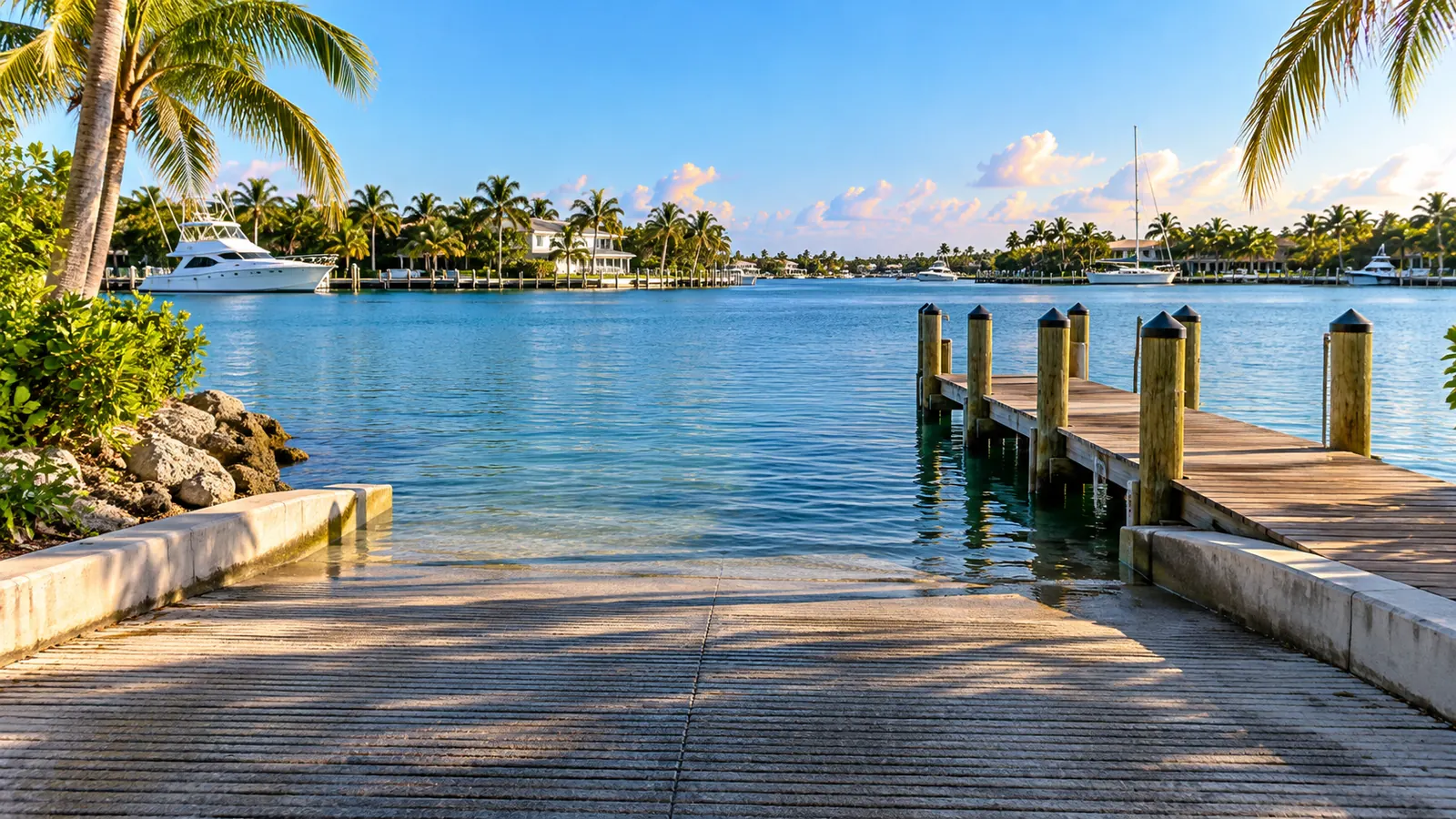
City launching sites
- Cooley’s Landing, 450 SW 7th Avenue on the New River: the city lists boat access and a ramp among the park’s amenities, along with parking, restrooms, a fishing area and a marina office open daily 8 a.m. to 5 p.m. Phone (954) 828-4626.
- Cox’s Landing Boat Ramp, 1784 SE 15th Street: the city lists it as one of its four free sewage pump-out stations, self-service and open 24 hours.
The city says boat ramp and marina parking is handled through its parking services, and fees and permit rules can change. Call the marine office before your first launch to confirm hours, parking and any fees, and ask where trailers may be left.
Tip: From Cooley’s Landing you will run the New River to reach the Intracoastal: no-wake speed and several bridges, including a railroad bridge with 4 feet of closed clearance. Read Bridges and Clearances on Fort Lauderdale’s New River: Heights, Rush-Hour Rules and the FEC Railroad Bridge first.
Before you leave home: the paperwork
Florida’s registration law, section 328.48 of the Florida Statutes, requires most boats operated, used or stored on state waters to be registered, and it is specific about how the boat must be marked:
- The registration certificate is pocket-sized and must be aboard and available for inspection whenever the boat is operating.
- The registration numbers go on each side of the forward half of the boat, reading left to right, in block characters not less than 3 inches high, in a color that contrasts with the hull.
- The year’s decal goes on the port (left) side within 6 inches before or after the registration number, and old decals must be removed.
If the operator was born on or after January 1, 1988 and the boat has a motor of 10 horsepower or more, the operator also needs photo ID and a boating safety education card or an accepted alternative aboard. The details and exemptions are in Florida Boating Safety Education Card: Who Needs One, How to Get It and the Exemptions, and the registration classes and fees are in Florida Boat Registration: Who Needs It, What It Costs by Length and How to Display the Numbers.
Boats that need no registration
The same law exempts some boats. A non-motor-powered vessel less than 16 feet long, and a non-motor-powered canoe, kayak, racing shell or rowing scull of any length, does not need to be registered. Neither does a boat used only on a private lake or pond. Put a motor on a canoe, though, and it becomes Class A-1 for registration purposes, whatever its length.
A ramp routine that keeps the line moving
Ramps can get busy, especially on weekends. Doing the slow work away from the water is good manners and safer:
- In the staging area: load gear, put in the drain plug, attach bow and stern lines, remove tie-down straps except the winch strap, and check the engine is trimmed up.
- On the ramp: back down, launch, and move the boat clear of the ramp to a courtesy dock or hold it off with a line.
- After launch: park the tow vehicle and trailer where the site allows, then return to the boat.
- On retrieval: bring the boat to the trailer, winch it on, pull out, and only then strap it down and pull the plug in the staging area.
Safety gear the law expects aboard
Section 327.50 of the Florida Statutes requires the owner and operator of every boat on state waters to carry, store, maintain and use safety equipment according to current U.S. Coast Guard requirements. Two Florida rules go further and are easy to miss at a ramp:
- On a boat less than 26 feet long, every child under 6 must wear a Coast Guard-approved life jacket whenever the boat is underway, which the law defines as any time it is not anchored, moored, made fast to the shore or aground.
- The boat must have serviceable navigation lights and shapes as the navigation rules require, so check the bulbs before a trip that may run past sunset.
Out on the water
Most of the water near downtown is in regulated speed zones. The New River and the Stranahan River are no-wake, and large parts of the Intracoastal near Port Everglades are slow speed year-round, with extra zones on winter weekends north of Las Olas Boulevard. No-Wake and Manatee Zones in Broward County: Idle Speed, Slow Speed and the 25 MPH Rule explains what slow speed legally means. If you are heading offshore, read Boating Through the Port Everglades Inlet: Currents, Big Ships and Rules for Small Craft for the currents and traffic at the inlet.
Coming back
If your boat has a holding tank, Cox’s Landing’s free self-service pump-out is open around the clock. Florida law prohibits discharging raw sewage from any boat in state waters, and the civil penalty for sanitation violations is $250. For fuel and other pump-out options, see Fuel Docks and Pump-Out Stations in Fort Lauderdale: Where to Fill Up and Empty the Tank Legally.